Keep a Log - Write your
goals down and keep an activity log to
make sure your health and fitness
program stays on track. Remember that
you should always consult a doctor
before starting any new fitness program.
The American College of Sports Medicine
has established the following guidelines
for a safe and productive weekly
program:
Cardiovascular
Goals - For general health
improvement, adults should engage in 30
minutes of moderate physical activity
most days of the week. The 30 minutes
can be broken up into smaller segments
throughout the day.
Charting Your Program - Once
you have decided on your overall fitness
goal and your weekly workout plan, you
need to log it, to make sure that you
are sticking to the program. Your
fitness chart should also include some
reminders of where you started and how
far you have come.
For example, if
your goal is weight loss, jot down your
weekly weight or measurements. If you're
trying to improve your muscle tone, take
some pictures or make some notes to size
up what is happening over the designated
training period.
Attitude
- Don't be discouraged if you miss an
intended workout or have a bad week.
Instead, work harder the following week.
And keep in mind that staying fit is a
lifelong process that takes place in
small, daily steps.
Tips for
Forming an Exercise Habit:
• Find
a friend to work out with; you will help
keep each other motivated.
• Try
working out at different times of the
day. Write down how you feel emotionally
and physically before
the
activity immediately after and several
hours later.
• Keep fitness and
healthy-eating articles, magazines and
books around for down time reading.
Put exercise at the top of your to do
list.
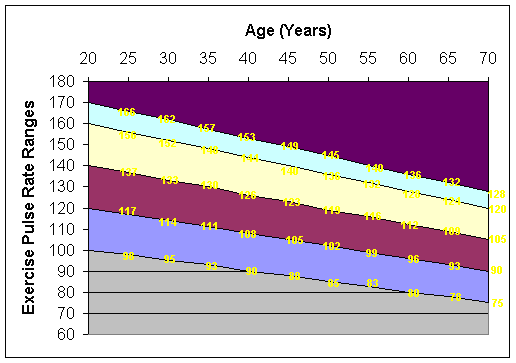
How Hard Should You Exercise
Your pulse rate taken immediately
after exercise indicates the
intensity the difficulty - of
your aerobic workouts. To receive
long-term cardiovascular benefit,
keep your exercise pulse rate within
levels 4 and 5.
|
Level 1
|
|
Active Living
|
|
Level 2
|
|
Moderate Activity
|
|
Level 3
|
|
|
Level 4
|
|
Aerobic Range
|
|
Level 5
|
|
|
Level 6
|
|
High Intensity Activity
|
Secret To Staying Healthy
The first step in achieving and maintaining health is taking personal responsibility. In this context, responsibility means choosing
a healthful alternative over a less harmful one. If you want to be healthy, simply make healthful choices. The second step is taking
the appropriate action to achieve the result you desire. Achieving and maintaining good health is usually quite easy if an individual
follows basic principals: Positive mental attitude, a healthful diet, and exercise. Trying to sell people on health is often
difficult. In order to be healthy, one needs commitment. The reward is not easily seen or felt. It is usually not until the
body fails us in some manner that we realize we haven't taken care of it. Ralph Waldo Emerson said "The first wealth is health."
The reward for most people who maintain a positive mental attitude, eat a healthful diet, and exercise regularly is a healthy life
filled with levels of energy, joy, vitality, and a tremendous passion for living.
Running and Cycling
Running - Running
is high impact exercise (high
compression on the joints) and is
recommended for intermediate and
advanced fitness level exercisers.
Running will enhance the muscular
strength and muscular endurance
levels of the mid-torso muscle
(abdominals and lower back) and
lower body's muscle groups (hip,
gluteals, quadriceps, hamstrings and
calves).
Incorporating a modified
swinging motion (forward and
backwards) with the arms will help
increase the exerciser's heart rate
level and tone the muscles of the
upper arms and shoulders. Holding
weights in the hands will increase
the tone of the upper arm muscles
and shoulder muscles.
The speeds and incline
levels for running are determined by
the exerciser's fitness level and
target heart rate zone. Increasing
the speed and/or incline level will
increase the difficulty level for
the exerciser. It is recommended
that the exerciser stay within their
target heart rate zone.
Cycling - Cycling is low
impact exercise (low compression on
the joints) and is recommended for
any fitness level exercisers.
Cycling will enhance the muscular
strength and muscular endurance
levels of the mid torso muscle (
abdominals and lower back) and lower
body's muscle groups ( hips, gluteals, quadriceps,
hamstrings, and calves.)
Investing in your Health
We all have made some kind of investment in our life. Some may have proved to be a "plus" and others a "bust".
Investing in your health is like buying an inexpensive form of "health insurance". Best of all, it will continue to give
you great pleasure and satisfaction. When you exercise regularly and correctly you LOOK-AND-FEEL BETTER